
Key takeaways
- The August 2026 spam update ran August 18 to 21, finishing in 2 days and 16 hours, the third spam update of 2026.
- Google's policy is unchanged: AI-assisted writing is allowed, and scaled content abuse (many pages made for rankings, not readers) is the violation.
- Publisher outcomes were mixed, with some recoveries and some collapsed Discover and Google News visibility reported by Search Engine Roundtable.
- AI-assisted publishing that survives spam updates shares four traits: real editing, demonstrated expertise, original data, and a recognizable voice.
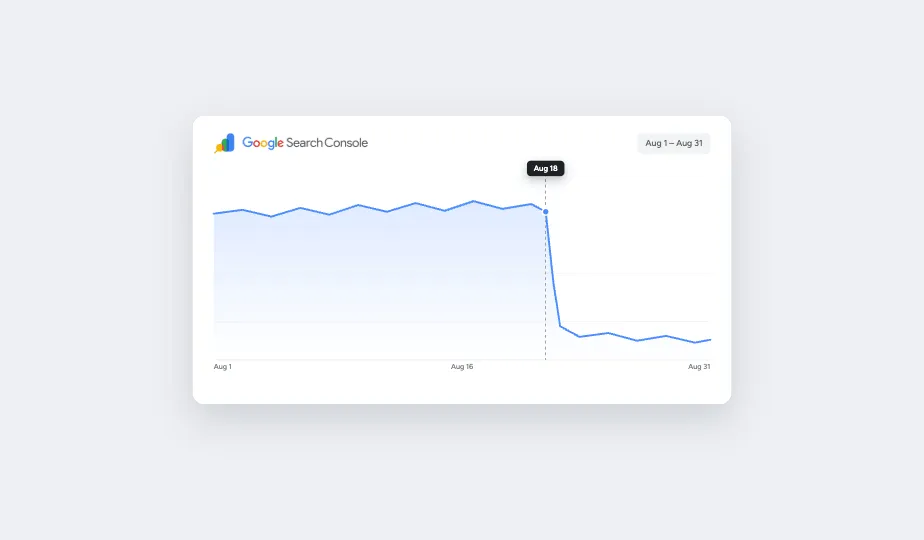
Google's August 2026 spam update started on August 18 and finished on August 21, a rollout of 2 days and 16 hours by the clock on Google's Search Status Dashboard. The August 2025 spam update needed almost 27 days. Enforcement is getting faster, and the target has not moved an inch. Google's position has not changed since early 2023. Using AI to write is allowed, and publishing piles of pages that help nobody is a spam violation, whatever wrote them. Which side of that line you publish on decided who woke up to a crater in Search Console in late August.
A fast enforcement pass, not a policy change
This was the third spam update of the year. The March 2026 spam update finished in under a day, the June update in about two days, and August in 2 days and 16 hours. Compare that with the August 2025 spam update, which ground on for 27 days. Google is running these passes more often and finishing them faster.
Google itself said little. Per Search Engine Roundtable's coverage, the company characterized it as a routine spam update enforcing its existing policies, applying to all languages and locations, with no specific technique named. Barry Schwartz's reporting through the window shows the usual split screen: some site owners celebrating recoveries, others describing Discover and Google News traffic falling off a cliff, and rank trackers (AccuRanker, Sistrix, Wincher, and half a dozen more) lighting up through the rollout. Volatility kept running past the official completion date, which Roundtable documented again the following week.
One complaint recurred in the comment threads. Specialist sites in narrow niches reporting that they had been displaced by large generalist resellers with no particular expertise in the category. That grievance is worth keeping in mind when we get to what Google says it rewards, because the gap between stated policy and observed results is where most of the frustration in this industry lives.
Does Google penalize AI content?
No. Not for being AI content. This has been Google's stated position since its February 2023 Search Central guidance on AI-generated content, and every policy document since has held the line. Ranking systems aim to reward helpful, original content regardless of how it was produced. We keep a running answer to this question in our post on whether Google penalizes AI content, and the August update gave us no reason to change it.
The condition sits one sentence away. Google's people-first content guidance states plainly that using automation, AI included, to produce content for the primary purpose of manipulating search rankings violates its spam policies. Purpose is the test. Google is not running your paragraphs through an AI detector and demoting anything that scores high. No Google policy document mentions any such threshold. What its systems evaluate is the outcome: whether the page is helpful and original, whether it shows experience and expertise, whether a reader's trust would survive learning how it was made. That last framing is Google's own, from the Who, How, and Why questions it suggests publishers ask about their content, alongside the E-E-A-T factors in the same guidance, with trust weighted heaviest and money-and-health topics held to the strictest standard.
What is scaled content abuse?
Scaled content abuse is the spam policy that matters here, and it is newer than most of the sites it hits. Google added it in March 2024, alongside site reputation abuse and expired domain abuse. The definition covers many pages generated "for the primary purpose of manipulating search rankings and not helping users," in Google's words.
Google's examples, paraphrased: using generative AI or similar tools to produce many pages that add no value, assembling pages by synonymizing or translating existing content without adding anything, stitching together feeds or search results, and running networks of sites doing any of the above. Notice what the examples have in common. The policy names the pattern (volume without value) rather than the tool. Ten thousand pages of raw model output is the canonical case, but a farm of human-written filler fits the same definition.
What actually gets hit
Spam updates are refreshes of SpamBrain, Google's AI-based spam-prevention system. They are algorithmic, which changes the recovery math in ways site owners routinely misread. There is no manual action notice in Search Console and no reconsideration request to file. Google's guidance for affected sites is blunt: review the spam policies, fix the violations, and then wait, because its systems need to observe compliance over a period of months before rankings improve. For link spam specifically, Google warns that any ranking benefit the spammy links produced is simply gone and does not come back after cleanup.
The historical hit list from these updates reads the same each cycle: mass-generated archives, thin affiliate pages wrapped around other people's product feeds, expired domains repurposed to carry content their backlinks never earned, scraped and lightly spun copies of other sites. The August 2026 round fits the pattern, with the Discover and News losses reported in Roundtable's comment threads suggesting this pass reached surfaces where scaled publishing had been quietly thriving.
AI-assisted vs. AI-scaled: the difference that decides your traffic
The distinction Google's policies gesture at deserves a sharper statement than Google gives it.
AI-assisted publishing uses a model the way it uses a keyboard. A human decides the page should exist, the model drafts, and then the human does the actual work: checks the claims, cuts the filler, adds what the model cannot know, and signs it. Publish rate is set by editorial capacity.
AI-scaled publishing inverts that. The archive is the product, publish rate is set by the model's throughput, and no individual page has an owner. Readers have a word for the output, and it is not a compliment. Slop is the reader-facing symptom of the same disease the spam team targets from the other end.
AI-assisted work that keeps surviving these updates tends to share four traits:
Real editing. Not a synonym pass. Sections get deleted, claims get verified, structure changes because an editor disagreed with the model's outline.
Demonstrated expertise. A byline that resolves to a real person, an author page with a track record, and details only a practitioner would include.
Original data. Your numbers, your tests, your screenshots, your client stories. A model can remix the public record, but it cannot generate evidence you own.
A recognizable voice. A first draft out of a model reads like everyone else's first draft out of the same model. Rewriting for voice is an editing job, and it is the job an AI humanizer exists to do. WriteHuman reshapes stiff, template-sounding drafts into prose that reads like a person wrote it, free to try on the homepage without an account. The facts, examples, and judgment still have to come from you, which is exactly the point.
How to keep AI-assisted posts safe
Publish at the speed of review, not generation. If your output rate exceeds what a human can honestly edit, you have crossed from assisted to scaled, whatever your intentions.
Add something the model cannot know. Every page should carry at least one thing that did not come out of a prompt: a measurement, a test, an example from your own work, a quote you collected.
Put a person on the page. Byline, author bio, and where it helps the reader, a note on how the piece was made. Google's own guidance asks whether your use of automation is self-evident to visitors.
Check how it reads before it ships. Running a draft through a free AI detector will not tell you what Google will do, and a high AI probability triggers no penalty by itself. What it flags is prose that reads flat and interchangeable, and that is worth rewriting on its own merits, because flat and interchangeable is what scaled content looks like to a reader too.
Prune the archive. Thin, redundant, near-duplicate pages are the exact pattern this policy exists to catch. Consolidate them or cut them before an update makes the decision for you.
Frequently asked questions
Sources (6)
- 1.Google Search Status Dashboard: Ranking updates historystatus.search.google.com
- 2.Google Search Essentials: Spam policies for Google web searchdevelopers.google.com
- 3.Google Search Central: Creating helpful, reliable, people-first contentdevelopers.google.com
- 4.Google Search Central: Spam updates and your sitedevelopers.google.com
- 5.
- 6.